
For this fxpodcast, we speak with lead visual effects supervisor Betsy Paterson about completing the fifth and final season of the Duffer Brothers’ landmark Netflix series Stranger Things. Paterson joined Stranger Things for season 5 and was involved for a little over three years, beginning as soon as scripts started to arrive. With a full year of preparation, her job was not to decide whether a shot should be “practical” or “digital.” It was to find the point at which every department could contribute its strongest work, then make the handoff invisible.
There is a curious problem with the way visual effects are discussed today. Inside the industry, filmmakers embrace VFX as one of the central tools of modern production. Publicly, however, there is still a temptation to insist that everything was somehow achieved in camera. Stranger Things has never had the luxury of that fiction. The Upside Down is not real, Demogorgons are not waiting in their trailers, and Vecna is far more than an actor in prosthetic makeup. What makes the final season so convincing is the way its exceptional cast and crew created as much as possible practically, giving the visual effects artists real performances, physical interactions and photographed detail from which to build.
That philosophy runs through everything from Jamie Campbell Bower’s performance as Vecna to the fully CG Demogorgons, the vast final battle and the extraordinarily difficult deaging of a young Will.
The practical–digital handoff
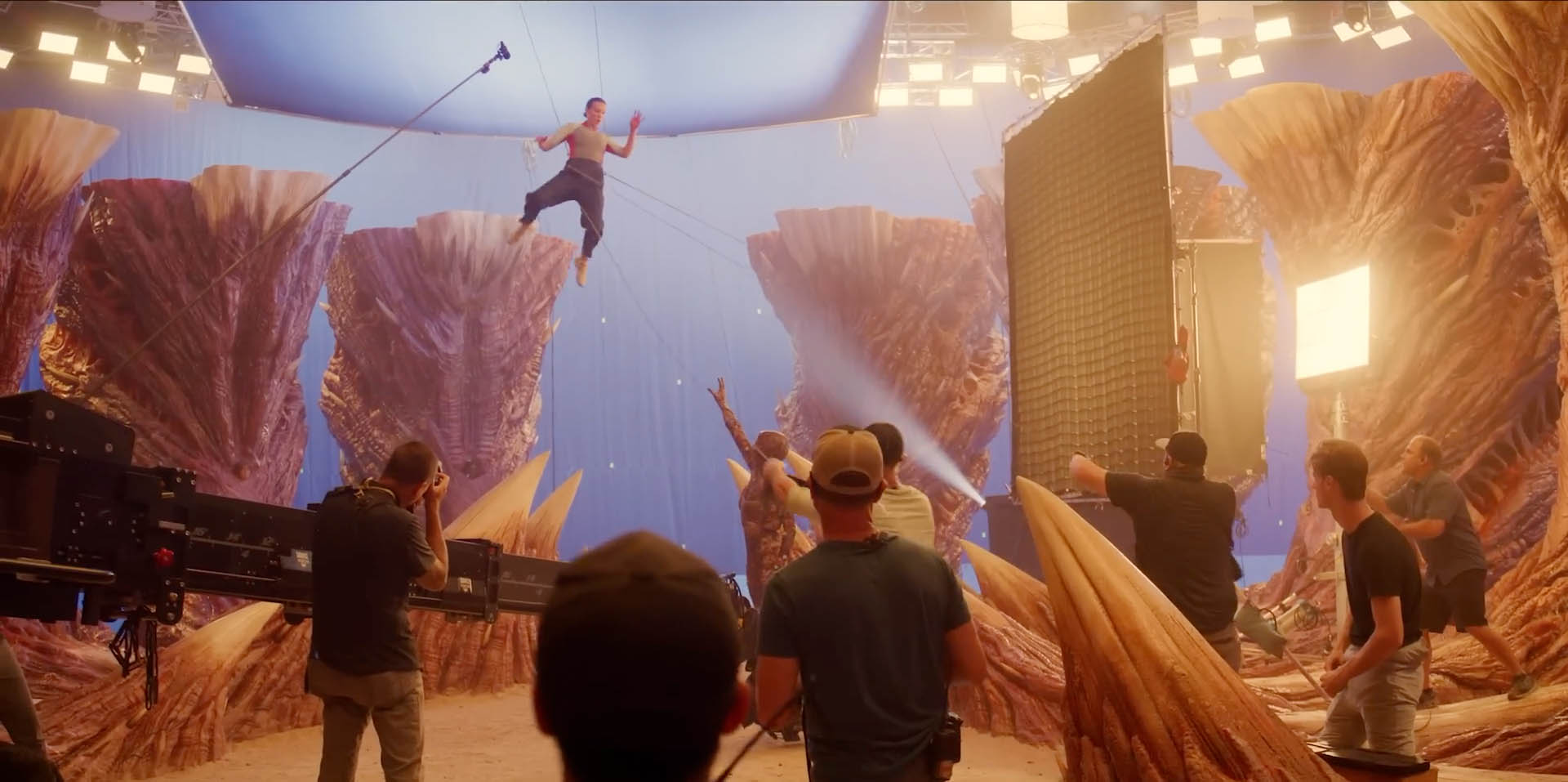
Paterson’s starting position was to make as much of each event physically present as possible. A Demogorgon may be entirely computer generated, but the vase it knocks from a table can be real. The table can move on set. A stunt performer can be pulled on wires rather than replaced with a digital human. Small air hits, fishing-line pulls and carefully weighted stand-ins give actors something to feel and the camera something concrete to photograph.
“We need to do as much real as possible, and the line becomes when it is just not possible anymore,” Paterson explains. “Yes, the Demogorgon is fully CG, but we work really hard to make sure the stuff it interacts with is real.”
These are not merely reference elements for post. They affect the performance. Paterson’s team worked closely with special effects, stunts, production design, costumes, hair and makeup to provide eyelines and physical resistance. Sometimes the solution was as modest as the right kind of sandbag for an actor to carry and stab. The aim was always to let the cast and camera crew feel the pressure of a creature occupying the scene.
Previs became the common language for those decisions. It established the large pieces of blocking, where a monster stood, how big it was and the direction in which an actor had to run, while leaving room for the smaller actor choices that emerge during rehearsal. That distinction matters. An actor should still be able to act, but the larger geography must survive if a creature is to be integrated believably later.
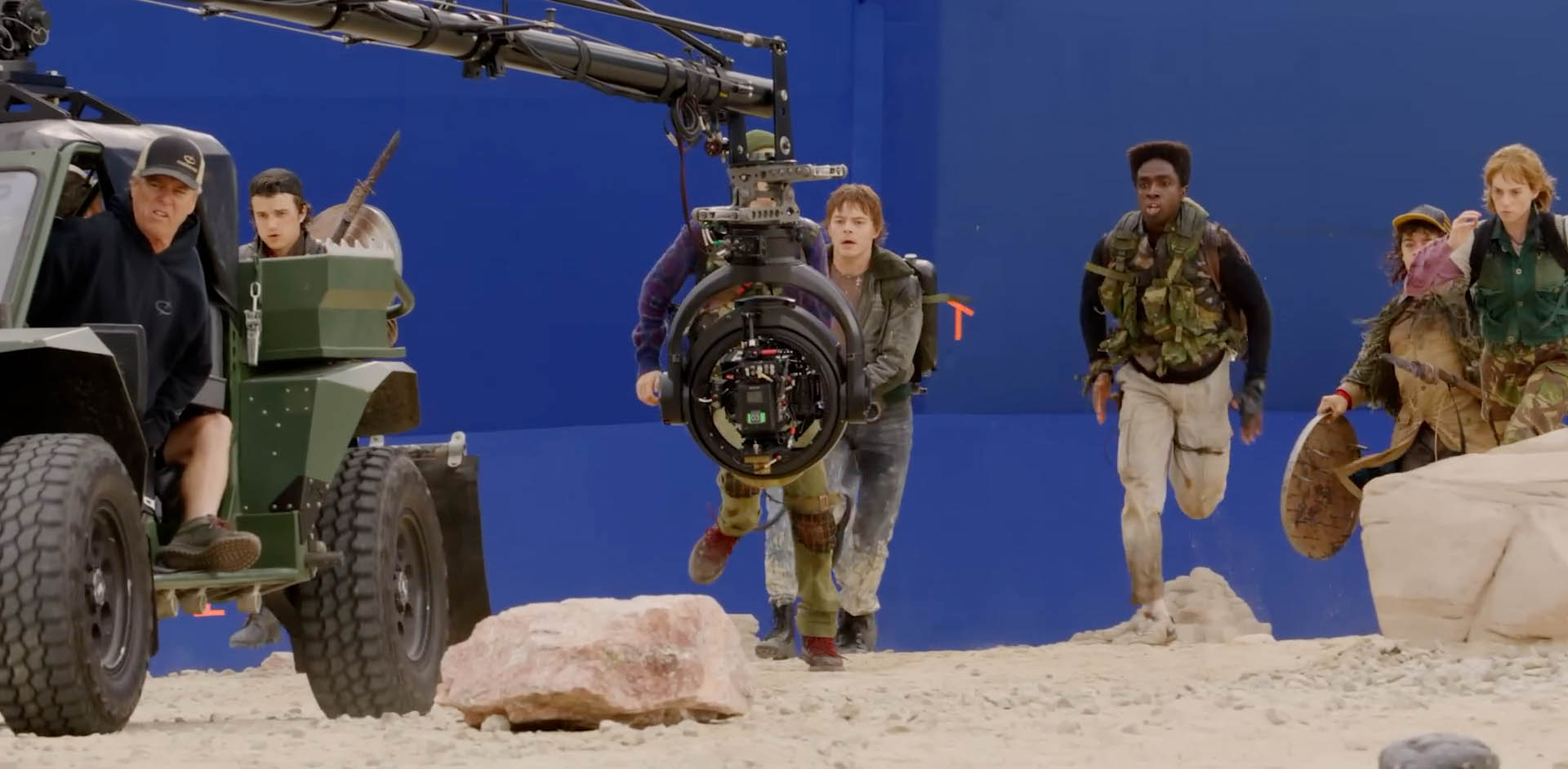
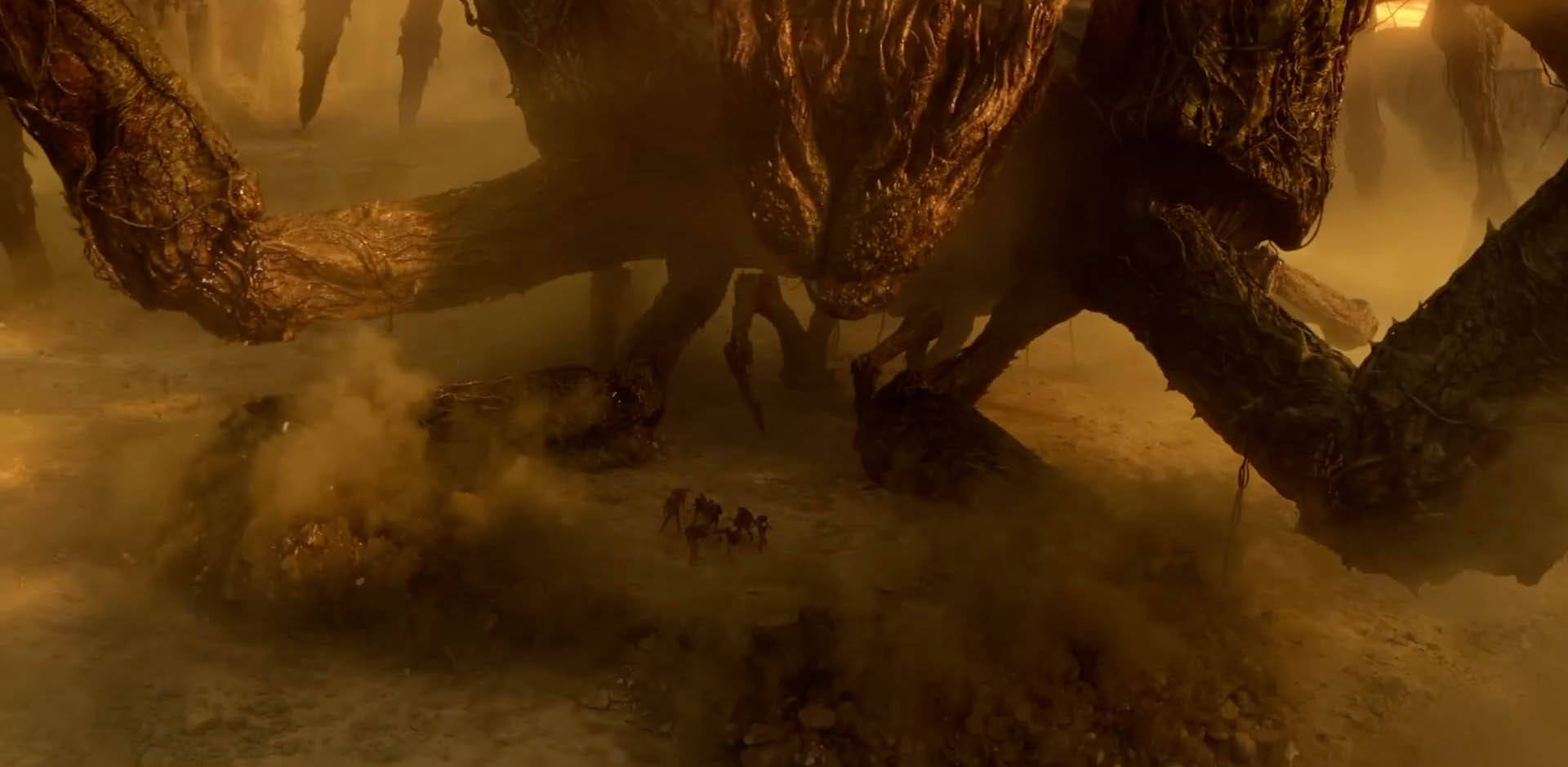
For a major final quarry sequence, the production used an augmented-reality setup that allowed the crew to view the creature at scale through an iPad. The virtual camera could identify a physical landmark corresponding to the CG character, while practical sand bursts marked its footfalls during the take. The performers were not asked simply to imagine that something dangerous was behind them; the set gave them timing, scale and impacts.
The location itself was a hybrid. Its design drew on a real canyon in New Mexico, but filming everything there would have been difficult, and the geography would not necessarily have served the action. The team therefore mapped the environment in previs, shaping its length and turns around the required beats, then photographed the actors on the rocky floor of a quarry surrounded by bluescreen. Because the spatial design had already been resolved, backgrounds could be repeated and cheated without losing the logic of where the characters were meant to be.
Vecna: preserving Jamie Campbell Bower’s performance
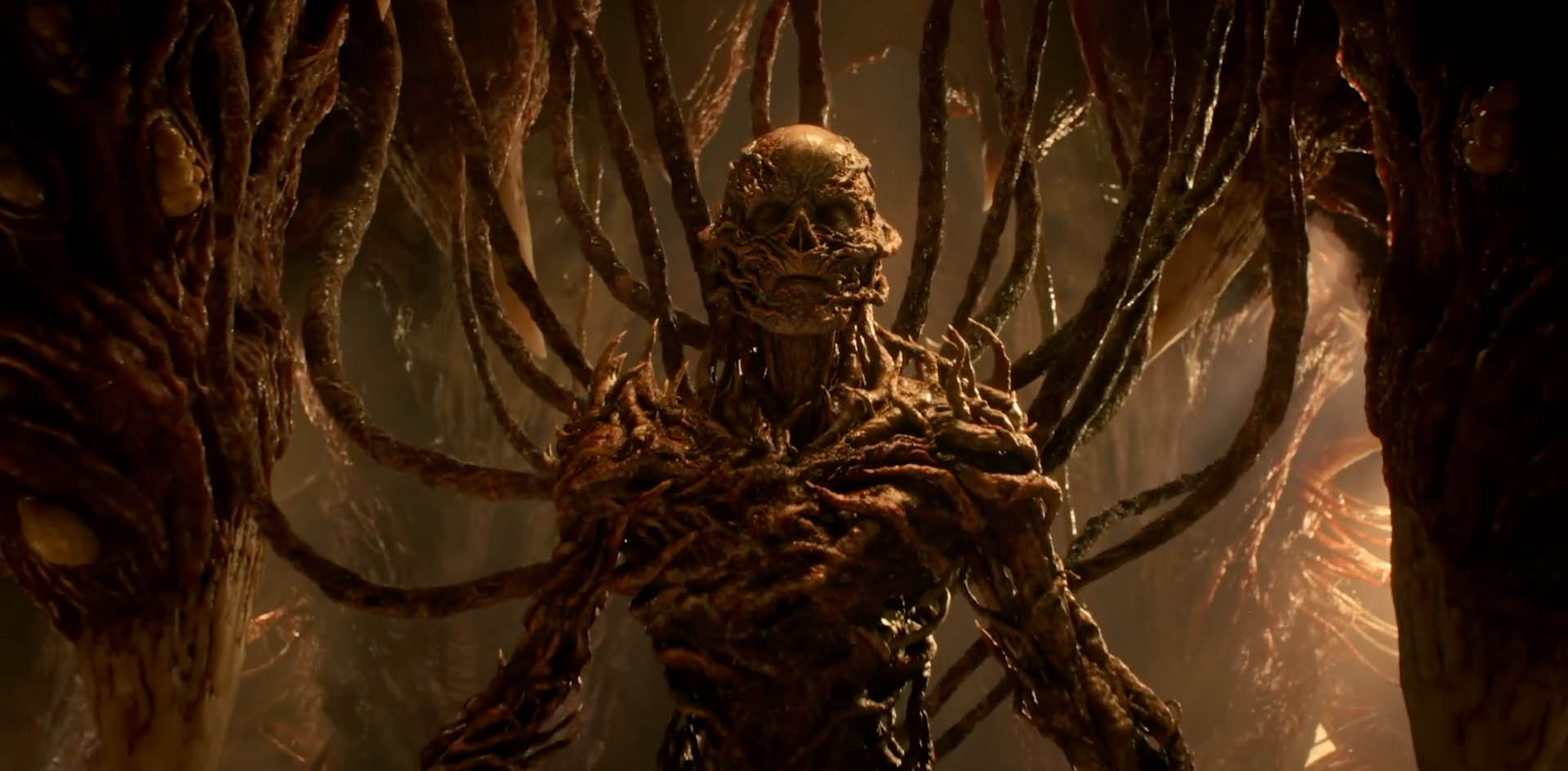
Vecna offered a more complex version of the same problem. It would have been possible to treat him as an entirely digital character driven by motion capture, but the Duffers and Paterson wanted Jamie Campbell Bower physically in the scene. In all but a handful of shots, he was there on set, including much of the demanding wire and stunt work.
The production retained as much of Gower’s practical work as it could, while Bower wore a close-fitting suit with minimal tracking marks for the extensive digital body replacement. It was not the most efficient solution in a narrow technical sense. It did, however, mean that Bower arrived as a frightening presence rather than an actor in a conventional motion-capture suit, giving both him and the rest of the cast something much closer to the final character.
“It was really important to everyone that it is Jamie’s performance,” says Paterson. “The fear was that people would not have taken him as seriously, or he would not have felt as comfortable getting into character. It just would not have been as scary.”
Bower even requested shoulder and underarm padding after seeing animation tests of Vecna’s broader silhouette. Wearing the FX suit made him feel too slight, so the padding helped him find the stance and physical presence of the final body. The choice created additional paint and replacement work, but it also fed directly back into the performance.
Season 4’s full makeup could require eight or nine hours in the chair. For Season 5, the team found a different balance: roughly two hours of practical application, enough to preserve the crucial facial presence, followed by Wētā FX’s extensive digital work. Wētā FX visual effects supervisor Martin Hill and his team naturally wanted the cleanest possible capture, but the on-set requirements were equally important. The result was a negotiated minimum of simple tracking dots rather than a full suit and facial camera rig.
This is the essential point: the apparently compromised capture was not a failure to plan. It was the outcome of planning. Everyone understood which information Wētā FX needed the most and which parts of the on-set experience the Duffers were unwilling to surrender.
“Even if you are going to replace every pixel, it gives everyone a very solid point of reference for what the shot really is,” Paterson adds. Starting with Bower in the frame meant inheriting the creative decisions already made by the actor, director, cinematographer and crew, rather than attempting to rediscover all of them from a blank CG scene.
Evolving the Demogorgons
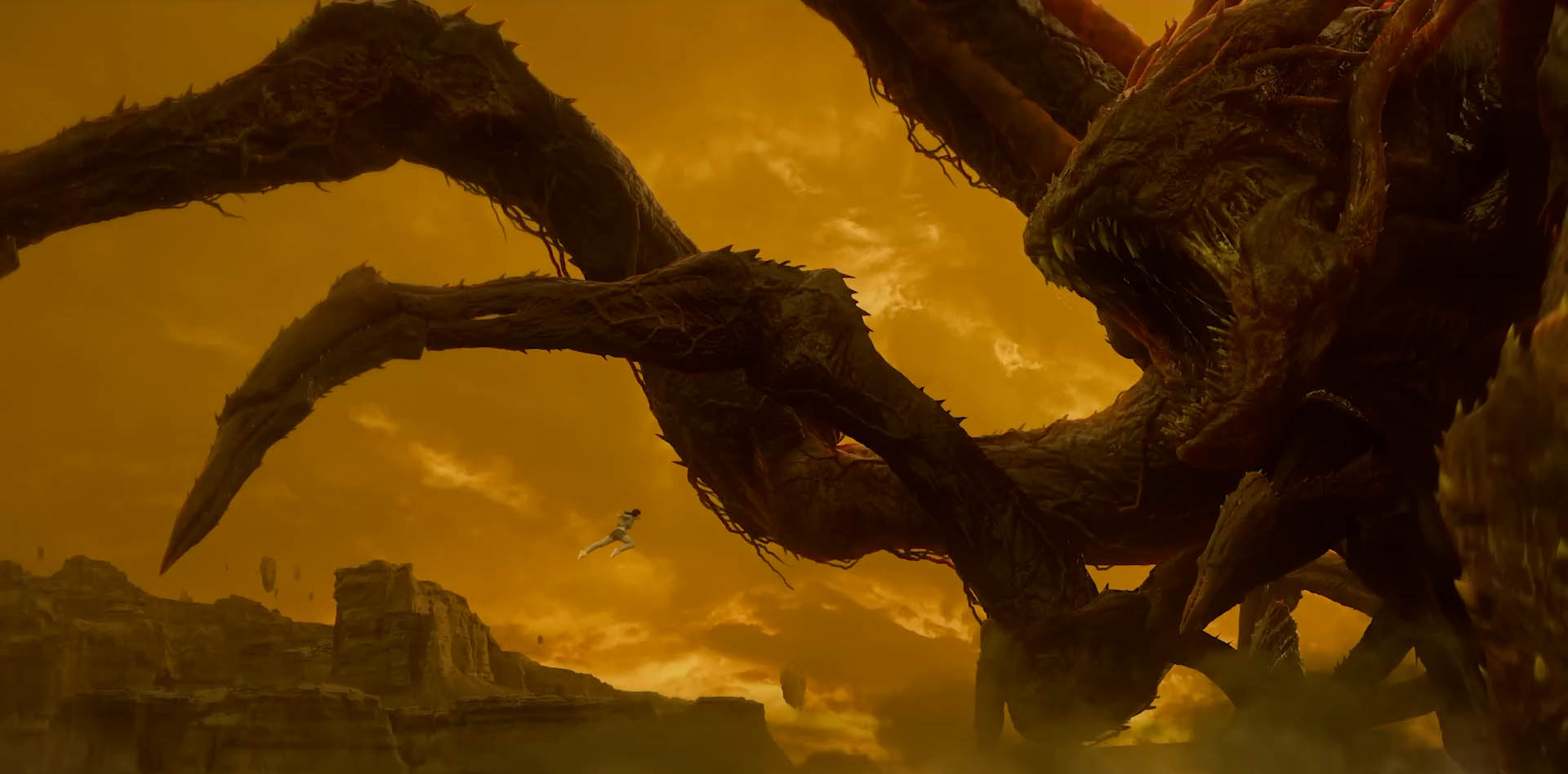
The Demogorgons presented a different challenge. Audiences already knew the creatures, but Season 5’s script asked them to do more and placed them under greater scrutiny. Paterson was not interested in changing the design simply to put a new signature on it. She did, however, see an opportunity to refine how the shoulders and hips moved, rebuild aspects of the run and improve the muscle simulation.
The goal was continuity with a decade of established screen history, enhanced by what current tools and artists could now deliver. Better subsurface response, more convincing slime and a considerable amount of slobber all helped the creatures sit more forcefully in the photography.
None of those refinements is intended to be noticed as a technical achievement while a Demogorgon is attacking. They exist to collapse the distance between the viewer and the event. As Paterson puts it, “If it helps him feel like he is really in the room, that is worth it.” The same applies to Vecna: if the audience can almost feel his toes pressing into the unpleasant carpet of a house, the shot has acquired a physical reality that makes the scare work.
Lighting provided its own complications. Industrial fight sequences mid-season used violently flickering fixtures whenever Demogorgons were present. The chaos helped continuity across cuts, but each vendor still had to reconstruct where those sources were and reproduce their changing effect on a digital creature. The light could feel random to an audience; its interaction with the CG could not be.
Production design also made seemingly trivial but enormously valuable contributions. Glass walls in the laboratory and radio-station booth were all built to be removable or capable of slight tilt adjustment per shot. On each setup, the team could decide whether to retain the real reflections, subtly change their angle or remove the glass for replacement later. It is a small example of experienced departments designing for the whole process rather than leaving post-production to rescue an inflexible set.
Young Will: nowhere to hide
The opening of the season saw the return to young Will, and this sequence was at the top of Paterson’s ‘risk list’ from the moment she read the scripts. The shots had to reconnect directly with earlier and it would start the final season with sustained close views of a ‘VFX face’ the audience knew intimately. A poor result would not be hidden by explosions, fast cutting or a crowded frame.

The production cast a young performer, Luke, whose proportions and appearance recalled Noah Schnapp at that age. Schnapp worked with him on set, discussing the wide eyes, trembling mouth and other qualities of his original performance. The younger actor supplied the body and the underlying acting choices; Wētā FX then created the face of young Will.
Paterson explored the available approaches with both ILM and Wētā FX. A machine-learning (AI) face replacement might produce strong individual results, but it would offer less control when the Duffers wanted a very specific adjustment. The safer creative route was a traditional fully CG face, supported by an unusually rich capture package.
The young performer wore facial tracking dots. Two witness cameras were attached to the main camera and four more were positioned around the forest set, providing Wētā FX with multiple views from which to recover the performance. A Wētā FX supervisor was present during the shoot to make sure the team obtained the necessary data.
Every useful image of the original young Will was assembled for reference: Season 1 footage, alternate takes, outtakes, publicity material and interviews. Wētā FX’s R&D tests placed original and digital images side by side and challenged the production to identify which was real. Some remained distinguishable, but others did not.
For Paterson, the eyes arrived relatively early. The mouth was the real test. Tiny muscles and the particular way human lips transition through an expression are often where an otherwise excellent digital face reveals itself. Young Will speaks very little in the sequence, but when the team resolved a shot of him singing, Paterson felt the work had crossed an important threshold.
The completed sequence contains around 40 facial shots. The most spectacular actions were not necessarily the most difficult. A small stunt performer executed the jumps and falls, retaining a practical body throughout; only the head was digital. The shots that stayed in the pipeline longest were the quiet close-ups, including Will looking down from the tree and realizing what waits below. With a still camera, no rapid action and the entire frame directing attention to his expression, there was nowhere for the work to hide.
Even the tendril placed in Will’s mouth began with a physical interaction. The team fashioned a small scuba-style mouthpiece so the young performers could feel an object between their teeth and react to its removal. Wētā FX replaced it with the final organic form, but the action, tension and contact came from the set.
Finishing at extraordinary scale
Wētā FX and ILM carried similarly large volumes of work. Wētā FX handled much of the creature work, including Vecna, Demogorgons and Demodogs, along with young Will, Vecna’s lair and the vast Abyss battle involving the Mind Flayer. ILM contributed Demogorgon work but concentrated heavily on environments, including destruction in the Upside Down, the fleshy wall and the vine constricting Hopper. Eyeline, Rodeo FX, BigHug FX, BOT VFX and other teams added further work across the season, supported by a remarkably small in-house unit.
Managing that scale meant reviewing twice a day. On the busiest reviews, Paterson looked at more than 300 shots in a single day. Some sequences necessarily crossed vendor boundaries, creating dependencies in which one team could not final an element until another had supplied fire, reflections or environmental work. At times a temporary element made by the receiving vendor proved more appealing to the Duffers than the intended version, requiring both companies to realign around the newly preferred idea.
The final grade was equally collaborative. Because the show’s strongly coloured lighting could expose a mismatch that had been invisible under a neutral viewing transform, the colourist was involved early and worked in the same building as the VFX team. Paterson could take representative grades (LUTs) back to vendors, review scenes and, when time allowed, request a revised render rather than relying on achieving the final look just in the grade.
Season 5 is vast, but its most interesting lesson is found in those small loops between departments. A gimballed pane of glass, padding under an actor’s arms, a puff of sand at a CG footfall or a mouthpiece given to a child performer can each matter as much as a sophisticated simulation. They are all part of the same image.
Stranger Things could never have been made entirely in camera. Nor was it created by visual effects working alone after the shoot. Its monsters feel present because the whole production agreed, long before the final pixels arrived, on how reality would be shared.
Listen to this week’s complete fxpodcast conversation with Stranger Things 5 visual effects supervisor Betsy Paterson for the full story.