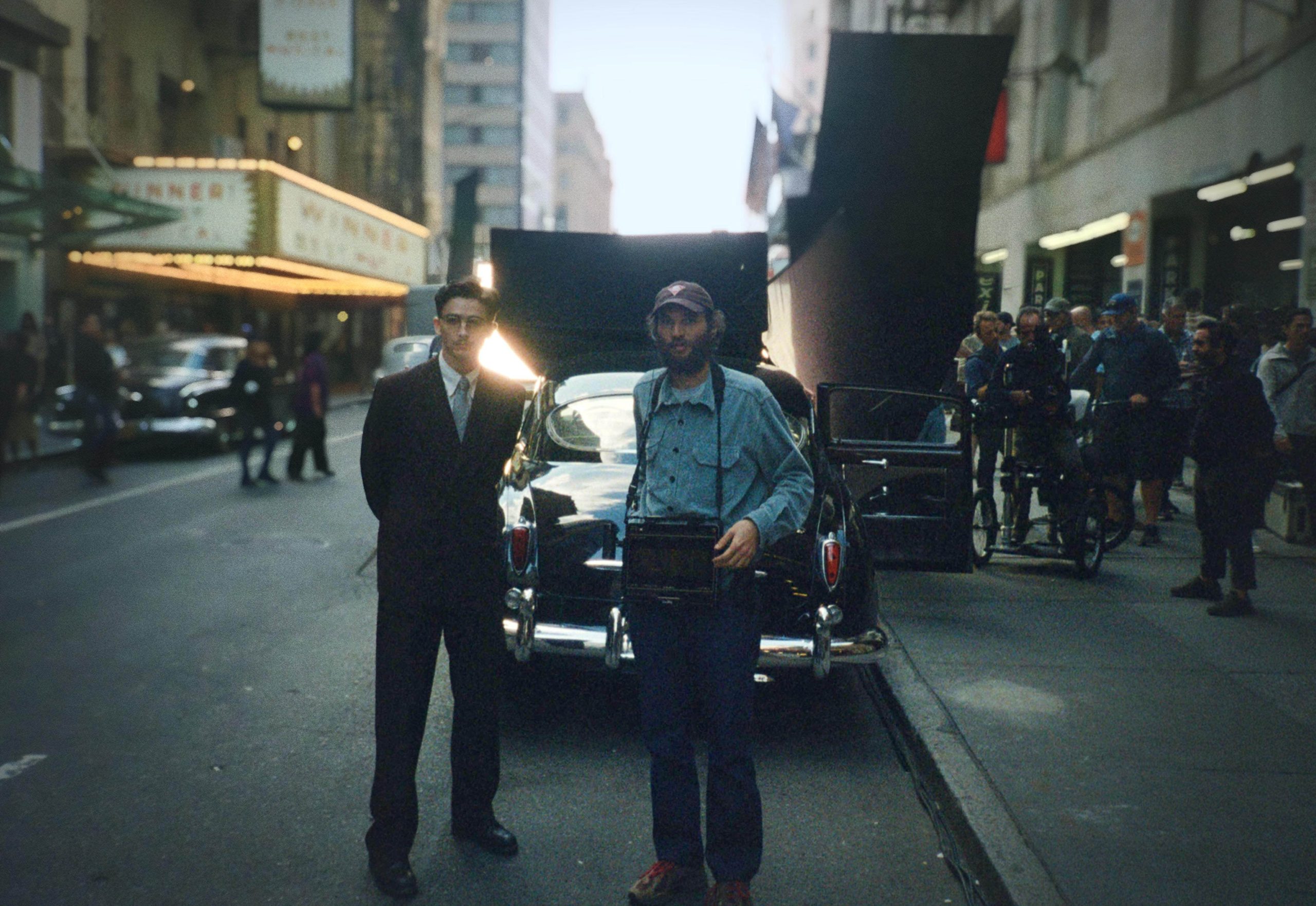
When audiences watch Marty Supreme, much of what they see feels raw, immediate, and almost documentary-like. Set in the gritty world of 1950s American table tennis, the film follows fictional prodigy Marty Mauser on his climb toward world championship glory, under the direction of Josh Safdie and co-writer Ronald Bronstein.
The film stars Timothée Chalamet. Marty Supreme looks like a throwback sports drama. But beneath its naturalistic surface sits a dense layer of visual effects work. At the centre of that effort is production VFX supervisor Eran Dinur, whose team focused almost entirely on making effects that audiences would never notice. “We wanted everything to feel lived-in and authentic,” Dinur explains. “Josh’s direction is always about realism. Our job was to support that, not compete with it.”
Making table tennis cinematic
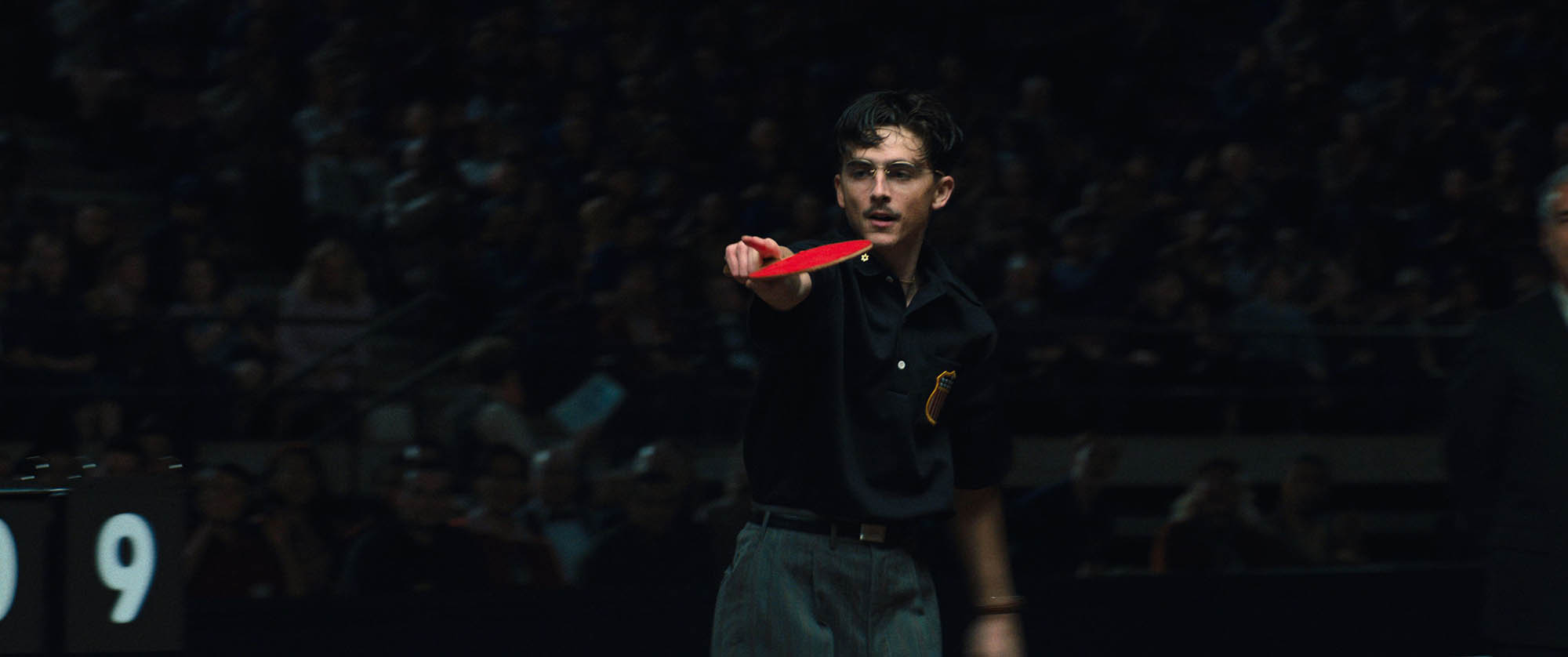
At the heart of the film are its match sequences, fast, chaotic, and emotionally charged. While much of the physical performance was captured practically. “Some shots used a real ball, but a substantial number, especially in the World Championship and the final Tokyo game, were done without one,” comments Dinur. “Timmy (Timothée Chalamet) and Koto Kawaguchi, who plays Koto Endo his nemesis, practiced extensively; every point was a preset choreography where they knew the exact spin and landing spot”. The team’s main concern was timing – being even a frame or two off would make the ball’s motion feel wrong. “Because Timmy is musical, his timing was perfect, and we didn’t need much retiming of actors. We hand-animated the ball for the choreography rather than using simulation to ensure it fit the script like an actor”.
Marty is loosely inspired by legendary table tennis player Marty Reisman, and that influence extended into the VFX work. The team stayed true to the physics, lighting, and scale of Reisman’s era. In the 1950s, the ball was actually smaller than they are today; “it was only made larger later to be more visible on TV,” comments Dinur. “We kept the realistic, slightly smaller size and never attempted to artificially emphasize it. We used the actual play physics, – top spin that made the ball dip and bounce hard, while under spin made it feel floaty with a smaller bounce”.
This got even more complex for the “Harlem Globetrotters” style trick sequences, where the actors are seen doing multiball shots with five balls, only here did the team have to cheat physics and perform some actor retiming to get the rhythm correct.
Scaling the world
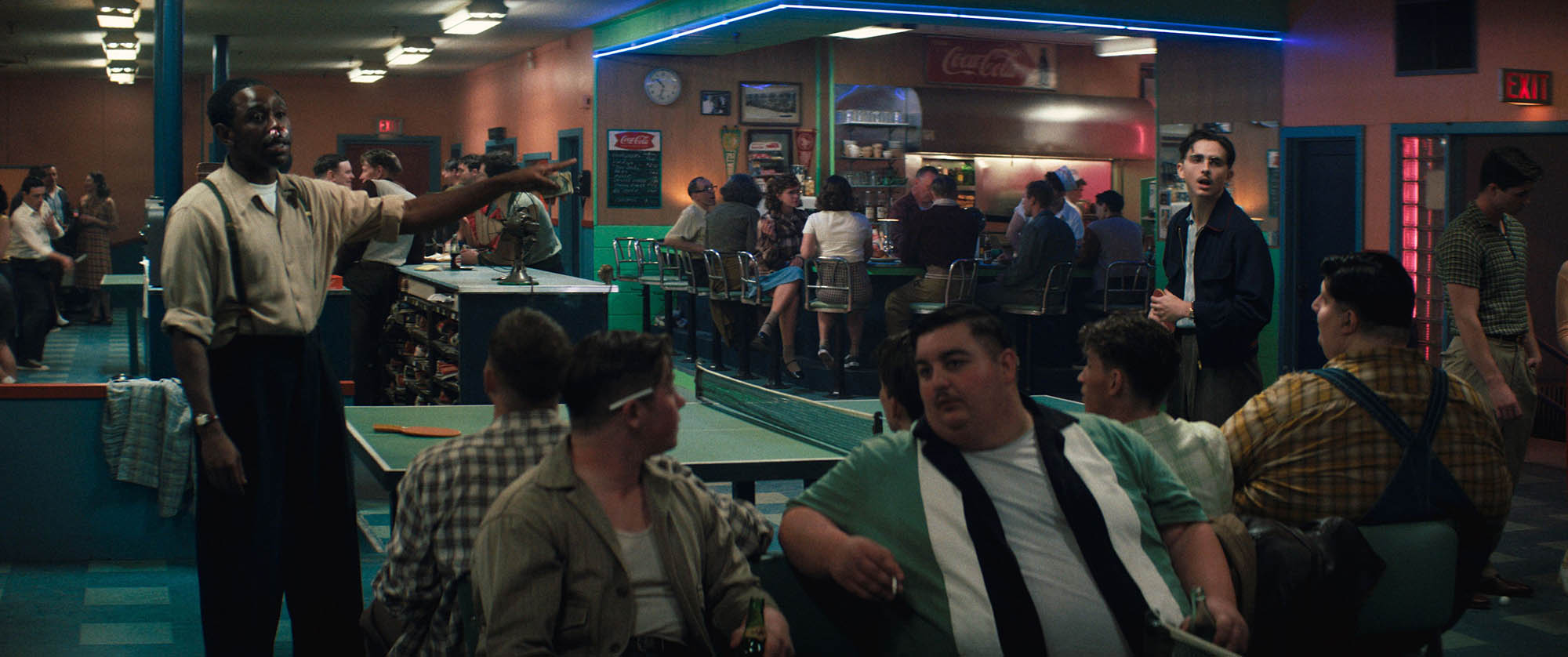
With supporting performances from Gwyneth Paltrow, Odessa A’zion, Kevin O’Leary, Tyler Okonma, Abel Ferrara, and Fran Drescher, the film moves through clubs, halls, and tournament arenas packed with spectators. In reality, many of these spaces were far smaller than they appear.“Sometimes we had 30 extras playing a crowd of 300,” Dinur says. “We decided against tiling because of the handheld camera motion, so we used fully CG crowds,” he explains. “We filled the foreground with extras, but eventually added CG people even on the floor to create a ‘full house’ feel.”
Dinur worked with two key VFX companies, Folks (Toronto office) and El Ranchito (Madrid), which are both part of the Pitch Black group. Folks handled the majority of the crowds, while El Ranchito handled 2D compositing for shots without much camera movement. “Matching the lighting and atmosphere—specifically the cigarette smoke and puffs of atmosphere Darius (the DP) likes—was a specific challenge.”
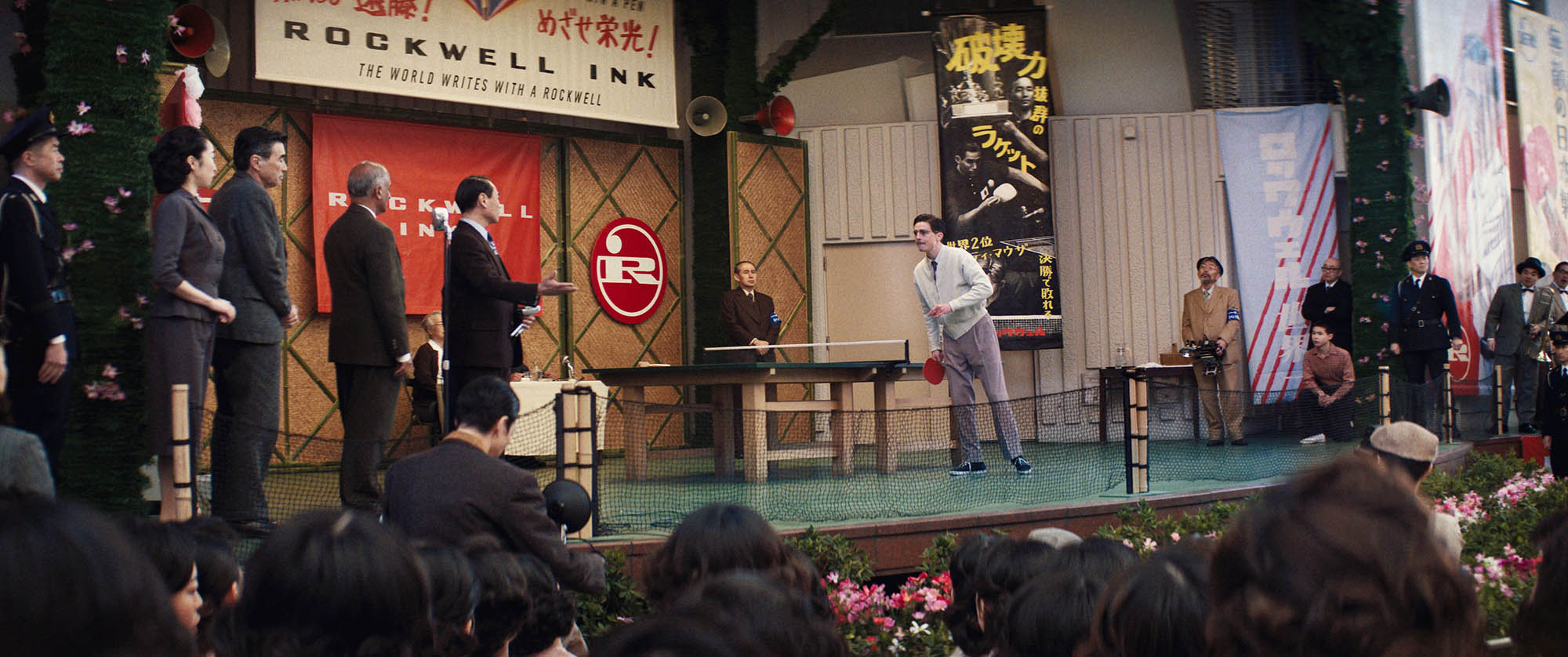
The Japanese match and crowd work was even more complex than the earlier Tournament in London. ”The Tokyo sequence is an open daylight amphitheatre where the crowd is closer and more active, ” he explains. “We had to create a huge cross-section of people: American servicemen, children, and people in kimonos, which are difficult to simulate because they are loose. We had to add enormous detail like mouth cavities so their mouths didn’t look like gaping holes when they were shouting(!)”.
Dinur explains the El Ranchito team even had to produce a CG dog for the Gas station explosion scene. ” We used real dog actors and a puppeteer for most scenes, but for the one shot where the dog falls off the car, we used a CG version.” Dinur offers full credit to the Special FX team for a completely believable dog, used in the backseat of the driving car sequences. “For the shot of the dog running away, we took a real dog from another shot and projected it into a recreated environment because the director wanted a specific POV”.
The VFX department collaborated closely with production design and cinematography. Safdie’s preference for immersive shots created some of the film’s biggest technical challenges. “These shots are chaotic by design,” Dinur says. “Multiple performances, camera passes, crowd plates, all had to be blended into something that feels spontaneous.”
Origin of life sequence
There was one key fully CG sequence at the start of the film. The origin of life sequence at the start of the film was all done by The-Artery with VFX Supervisor: Yuval Levy, and Executive VFX Producers Vico Sharabani and Deborah Sullivan. The sequence is a stylised or retro animation of sperm fertilising an egg, which match-dissolves into a ping-pong ball at the end of the sequence. The sequence is a key narrative point, that ends up bookending the whole film.
A world that feels real
The VFX team’s also had to account for the unique distortion patterns of the old 1960s glass lenses used for the big zoom shots. “We shot mostly on anamorphic film for exteriors, but used digital for dark interiors like Wembley. We even used three different old 8mm cameras for news footage”. In the film, cameramen seen filming the Wembley match with period cameras were actually shooting 8mm footage that would be used later in the film.
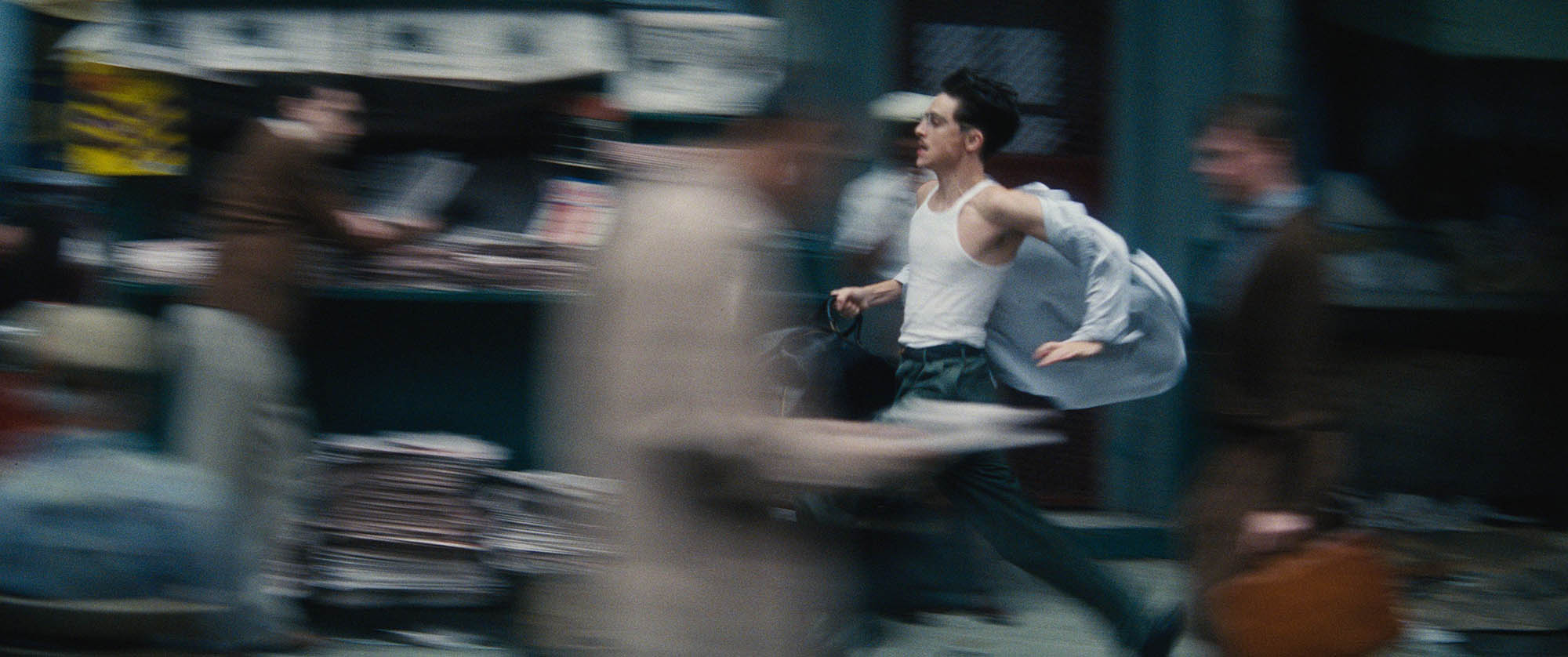
Looking back, Dinur measures success in simple terms.“If audiences believe they’ve stepped into 1957 and watched a real person chase a dream, then we’ve succeeded,” he says. With Marty Supreme, invisible visual effects, period authenticity, and character-driven storytelling combine to create exactly that illusion, one that feels effortless, even though it’s anything but.
At the time of writing, the $70M Marty Supreme has become studio A24’s highest-grossing worldwide release with $147 Million in box office, overtaking Everything Everywhere All at Once. Furthermore the film has secured nine nominations for the 2026 Academy Awards. Key nominations include Best Picture, Best Actor for Chalamet, Best Director, and Best Original Screenplay.