
Happy Back to the Future Day! To celebrate we’re going back to the old-school hand-drawn and optical effects work that ILM created for the film. In the days before digital compositing and modern CGI, effects animation was done by meticulous hand drawn frame-by-frame drawings which were then optically printed with the live action plates. On the Back to the Future trilogy, ILM animator and supervisor Wes Takahashi pioneered effects for the Clock Tower lightning bolt and Dolorean time slice sequences. We asked him about his memories of that work.
The first time travel shot featuring Wes' effects animation.
fxg: For the first film, what were the initial ideas and elements behind the time slice effect – what kind of iterations did you work through?
Takahashi: Phil Norwood, the ILM Art Director assigned to this show, and I spent weeks trying to come up with concepts that would envision what the two Bob’s wanted for the film’s Time Slice effect. The only marching orders we were given were that it must be something we’ve never seen before and the quote from Zemeckis, “I want it to be violent, like a Neanderthal sitting on the hood of the Delorean and chipping away the fabric of time in front of him – or something to that effect.”
We worked out many versions. One that I particularly liked was Phil’s Cubist car effect where portions of the car would pop in and out like some distorted cubist abstract painting as it reached 88mph. I t didn’t wash with Zemeckis though.
I just busied myself with a whole assortment of effects from glowing lights to flashes and comets and contrails. In the end Bob wanted to use all of my animated effects in a cacophony of FX insanity.
Marty's goes back in time to 1885.
fxg: Can you talk about the different elements that you ended up drawing and animating for the time slice effect for both going into and out of time? What details should people look for say on a Blu-Ray or HD version that they may not have noticed before?
Takahashi: The original Delorean had all these mods built on and there was some tubing affixed to the exterior that I thought would look cool if I turned them into glowing blue neon. This entailed hand roto-ing each frame of the tubing and giving the Optical Department timings as to when to DX (double expose) some light onto those elements. Again, we used hot inner core passes and a diffused outer core for a glow.
From these blue glowing tubes animated white flashes would pop and animated comets would be emitted form each flash event.
These comets would be directed towards the front of the car and bounce off of an invisible barrier which caused the fabric of time to open up bit by bit exposing a violent time slice that got closer and closer to the car as it reached 88mph until finally the car would enter the time slice in a moment of singularity initiating an explosion implosion effect engulfing the car and making it disappear.
So all of these separate effects with the exception of the explosion implosion (which was a practical explosion that was printed on top of everything that was then printed running in reverse with some drop frames), were hand animated in pencil, air brush or inked artwork and then composited into the final effect.
– Glowing tubes
– Flashing pops
– Animated comets
– Animated contrails
– Animated sparks as the comets would bounce off of the fabric of time and space
– Time Slice opening up with bits tearing off
The train sequence in Back to the Future III.
fxg: What materials did you work with to draw and animate? What was your animation setup at ILM day-to-day?
Takahashi: Back in the days of the original BTTF the Animation Department consisted of Charlie Mullen Animation Supervisor, Bruce Walters Asst. Supervisor both of whom operated our motion controlled down-shooter animation cameras, Peggy Regan and myself as Animators, we were responsible for hand drawn animation and shooting the elements we came up with. We had multiple productions we were working on at the time at ILM, so I was primarily assigned BTTF. Working closely with Phil Norwood the Art Director assigned to this project who is an accomplished animator as well was always a creative collaborative effort.
ILM was a great sandbox in that era. We were allowed to experiment in any medium we chose, be it pencil on paper, ink and paint on cel acetates, creating light rigs on motion controlled rigs, using airbrush, dry brush, pastels and paints, we were free to take our own approaches.
fxg: What was the technical process in terms of turning your hand drawn work into final optical composites?
Takahashi: All of my animation for the sake of efficiency was eventually black ink, airbrush or pastels on white paper and shot as black and white printing elements for the Optical Department to add to the final composite. I worked closely with the Optical Department to determine the right exposures, diffusions and color applications.
fxg: You were originally asked to achieve the ‘largest lightning bolt in cinematic history’ for the Clock Tower sequence which meant the lightning would have been on screen for a long time – what issues would that have raised?
Takahashi: The original approach was an attempt to have this bolt of lightning creep up from far off in the distance towards camera and strike the clock tower. The clock tower wasn’t really shot with that composition in mind, there just wasn’t enough headroom in the sky so the bolt’s trajectory always came off as flat as it moved in z axis and didn’t allow for a lot of downward anticipation for the strike.
Plus, bolts of lighting are ephemeral events. Having one bolt on for a number of seconds runs the risk of it ending up looking like a white hair caught in the projector gate.
The Clock Tower scene.
fxg: What did you ultimately animate for the wide shot of the Clock Tower? What different parts made up the main lightning bolts and extra pieces of electricity?
Takahashi: I animated numerous takes of lightning hitting the tower. Bob Zemeckis while running one version on a Moviola stopped on one frame from that version that had a characteristic S shaped bolt. He said THAT’S what I want it to look like.
I mocked up a color illustration which he bought off on and I went to work animating it. It had a lot of uncharacteristic curves for lightning which I wasn’t used to.
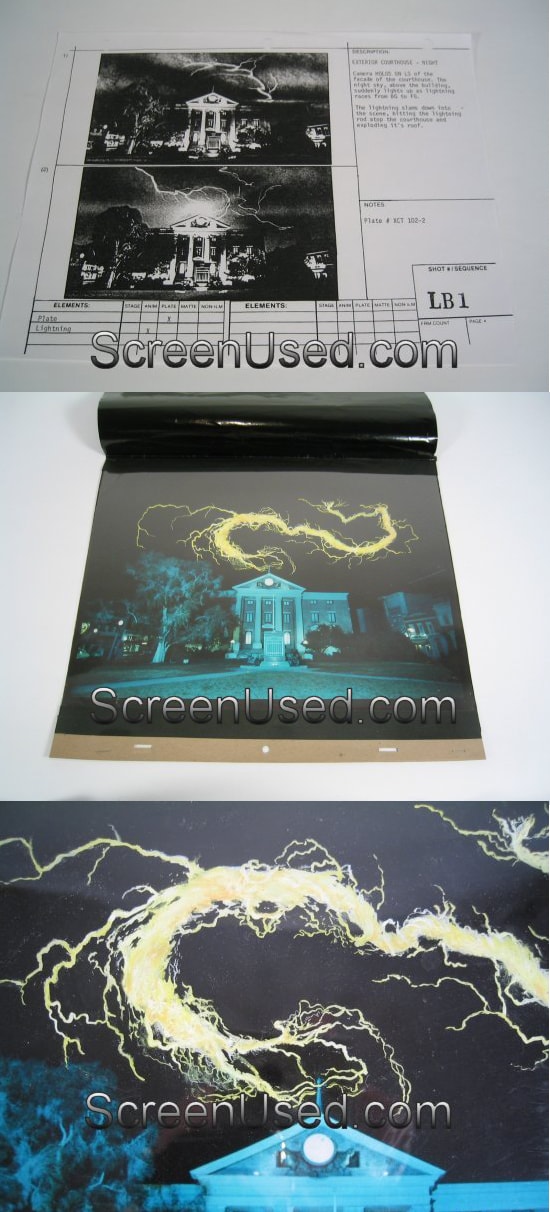
fxg: Can you talk about the animation techniques and tools you used to draw the lightning at the time? Was there any way you could ‘test’ the final look during production to see if it was working?
Takahashi: Animating the lightning was as easy as hand drawn black ink lines on white paper. In the animation department we could flip the polarity of our video animation test system, record each illustrated lightning bolt for one frame and immediately play back the series of frames in real time.
We would have to include a lined tracing on clear acetate of the background plate to give us a bearing for our animation tests, a cheap and dirty way to comp the lightning with the BG reference.
My work on the lightning “look” was always a close collaboration with the Optical Department when John Ellis was running the show. I would shoot hi-con black and white negative of black ink on white paper artwork that he could use as matte burn-in elements in his printers. Burn-in elements just exposed the background plates to a lot of light through whatever clear portions were on the black and white film.
The final process included the thick central bolts as one burn-in element. The thin tributary bolts as another burn-in element both printed with no diffusion. And, then another pass for both elements was added with a lot of diffusion to give the bolts their halation. We used to refer to these printer passes as the inner and outer core of each bolt of lightning. The thick and thin lines had to be printed as separate elements to be able to control the exposure correctly for both the hot inner cores and the diffused outer cores.
fxg: There’s a closer in shot of Doc Brown as the lightning runs through his hands holding the cable – how did you approach this look, especially in matching any interactive lighting on set?
Takahashi: Animating to the timing of the camera moves was the crucial element to those shots success. Ken Ralston and Scott Farrar’s work on set during production was what made it so easy. One needed to hit the marks in animation for the practical interactive light, but given the amount of control per frame hand animation offers that wasn’t a difficult feat. I lucked out with the design of the electricity running through the cables as it was pretty much a first take final with Bob.
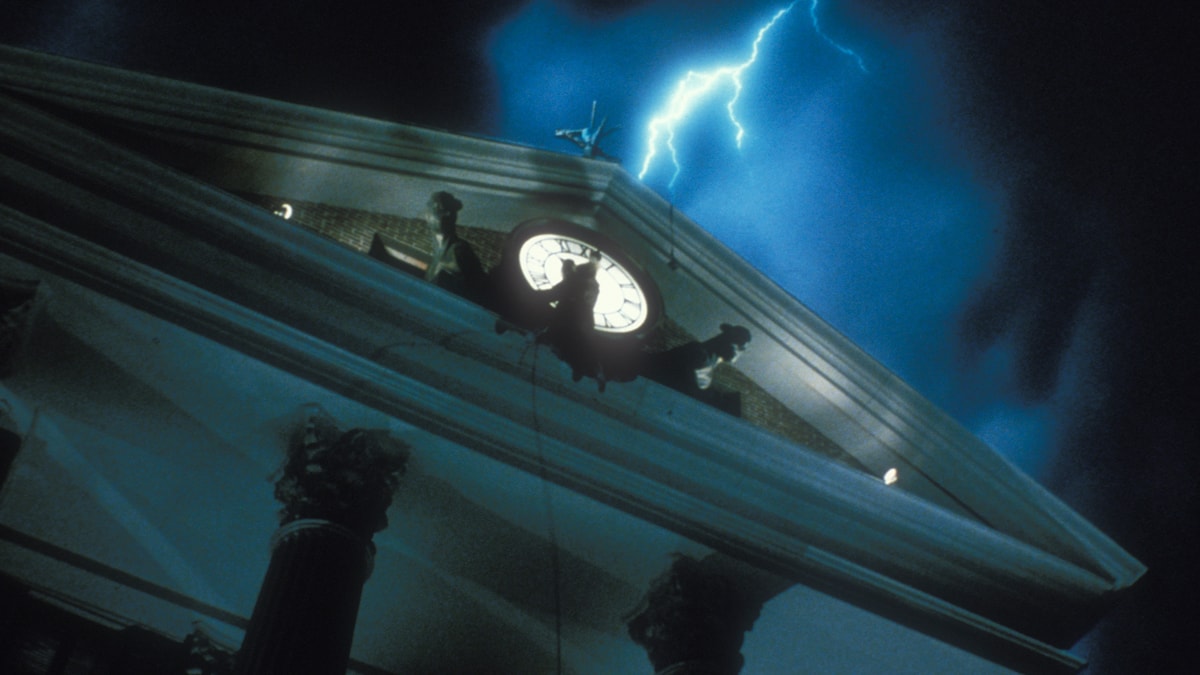
fxg: Then for the second and third films, can you talk about how you drew upon what you had done before to do the effects animation here?
Takahashi: BBTF 2 and BTTF 3 provided a lot of job security for me at ILM. I felt like I was a new aged Freemason who held the secret formulas to the Delorean time travel sequence of effects. John Bell who was the ILM Art Director assigned to BTTF 2 and BTTF 3 was a major force in the design of the look for the whole production at that time. He certainly put his stamp on the Hill Valley future, designing costumes, hoverboards, vehicles, props and environments. I just applied the same bag of tricks to the Delorean for each time travel sequence maybe adding a lot more sparks being emitted during the beat up, broken down version of the car back in the Wild West. John Bell gave me a good color illustration reference for train’s effects as it went in to time travel to work from. And there were always more lightning and electricity effects. The future is now upon us. I just saw a workable individual flying device that a person can stand on that can travel over land and water based on flying drone technology.
A 30th anniversary edition of the Back to the Future trilogy is now available.