
Beeble has announced SwitchHDR, a new AI model designed to reconstruct HDR imagery from conventional SDR video and output scene-linear 16-bit EXR sequences for professional post-production. The company is positioning the tool squarely at filmmakers, colourists and VFX artists who need to bring older, conventional, or otherwise limited dynamic range material into modern HDR finishing pipelines.
SwitchHDR is available through the Beeble web application, we have been testing it and we spoke to Hoon Kim, Founder & CEO, Beeble AI
Built on real HDR data.
The interesting claim here is not simply that SwitchHDR “converts” SDR to HDR. There are many tools that can expand or remap an SDR image into a larger HDR container. The more important distinction is that Beeble says SwitchHDR has been trained on real HDR footage, rather than primarily on the vast sea of SDR imagery that dominates the internet.
That matters because SDR video only captures a compressed slice of the original scene. Once a highlight has clipped, or once shadow detail has collapsed into noise or been heavily compressed, there is no clean mathematical way to recover the missing radiance. Traditional SDR-to-HDR approaches can redistribute the remaining signal, but they cannot truly recover what was never encoded. This is why many automatic SDR-to-HDR conversions tend to reveal banding, amplified noise, odd highlight roll-offs or plasticky shadow reconstruction.
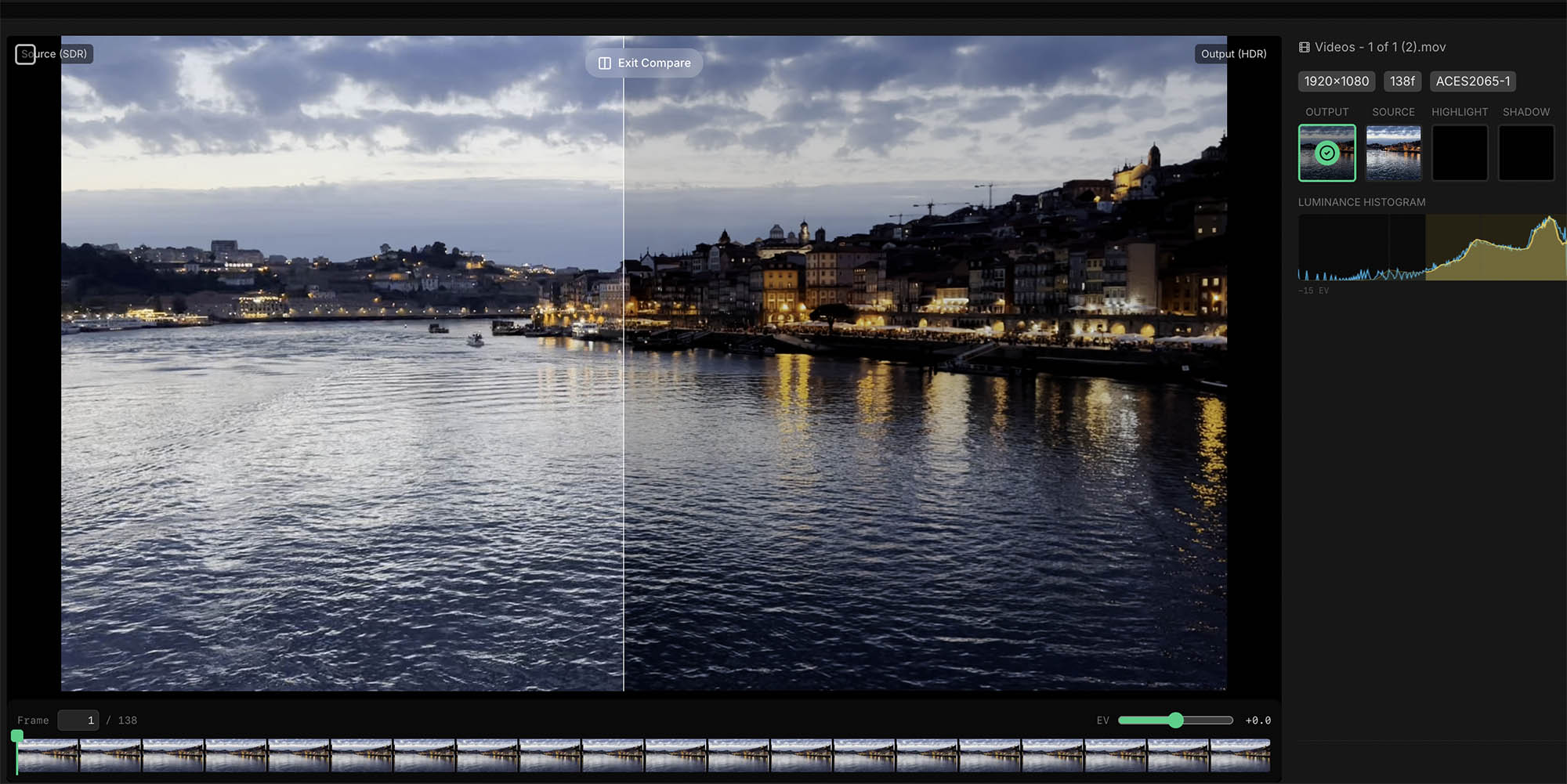
Beeble’s approach is closer to an informed reconstruction. SwitchHDR does not magically “find” information that is absent from the image. Instead, it infers a plausible HDR representation based on what it has learned from actual HDR footage. In practical post-production terms, that distinction is significant. The recovered values may not be physically or mathematically exact, but they may be visually close enough to allow the shot to be regraded, composited, and integrated into an HDR workflow in a much more convincing way than a simple signal stretch.
Given the complexity of the task we asked Hoon Kim about how they approached the problem.
VFX Use
SwitchHDR is a very VFX-relevant use of AI. In many production contexts, the question is not whether the inferred HDR is a perfect measurement of the original scene. The question is whether it gives the colourist or compositor enough believable latitude to work with the image. If the AI reconstruction avoids the more obvious failures of SDR expansion, such as clipped skies, crushed shadows, posterisation and temporal instability, – then the result can be extremely useful, especially for reusing archival footage, stock material, documentary sources, or older plates that need to live inside a contemporary new HDR master.
“Most of the world’s video exists in SDR, yet today’s productions increasingly expect HDR-quality assets,” Kim adds. “SwitchHDR bridges that gap by estimating a scene-linear HDR representation from existing footage, giving filmmakers a practical way to integrate SDR footage into modern HDR production pipelines while maintaining creative control.”
Kim, based in Seoul, South Korea, founded Beeble in 2022. Since then, the company has been developing a range of machine-learning tools aimed at production and post-production problems, particularly around relighting, compositing, and AI-assisted VFX workflows.
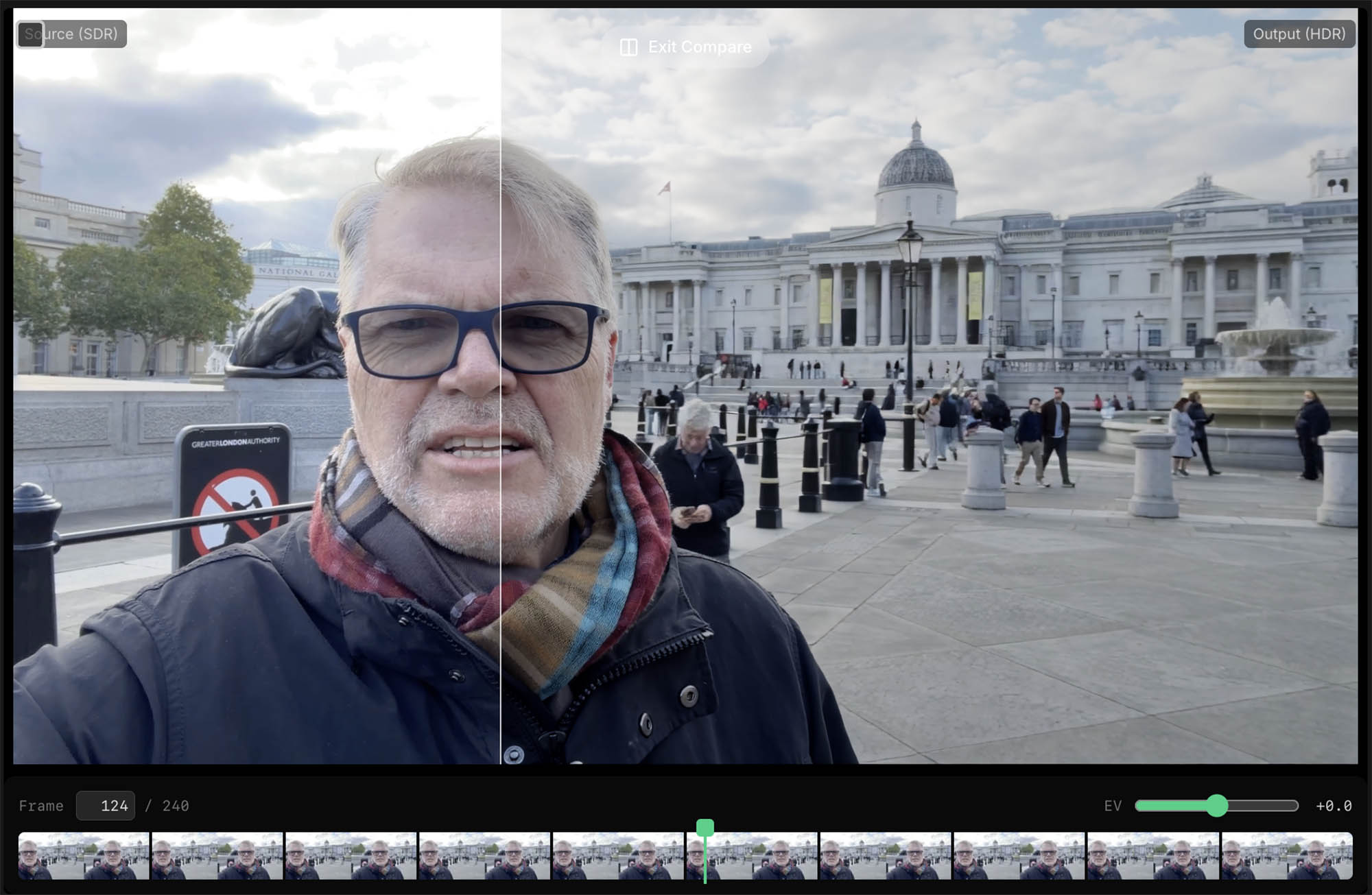
Controlled SDR-to-HDR
One of the more important aspects of SwitchHDR is that it is not just an automatic, one-button SDR-to-HDR process. Beeble has built-in direct artist control. Users can define highlight and shadow regions with luminance masks, and then guide the reconstruction with separate text prompts. HDR reconstruction can be applied only to selected regions, while the rest of the image is passed through without AI reconstruction.
That is a smart production-oriented decision. In VFX and colour, control is often more valuable than automation. A model may infer a highlight in a way that is technically impressive but not creatively appropriate. A director may want a window to remain blown out, or a colourist may prefer a more restrained highlight recovery. By allowing the artist to target only certain regions and guide the reconstruction, SwitchHDR becomes less of a black-box conversion tool and more of an assisted VFX and finishing tool.
The output is delivered as scene-linear 16-bit EXR sequences in ACES2065-1, using the AP0 colour primaries. This means the result is intended to sit inside real professional workflows, rather than simply producing an HDR-looking file for display. For VFX artists, the EXR output is especially important, as it allows the reconstructed material to move into compositing or finishing pipelines in a format that is already standard and production-ready.
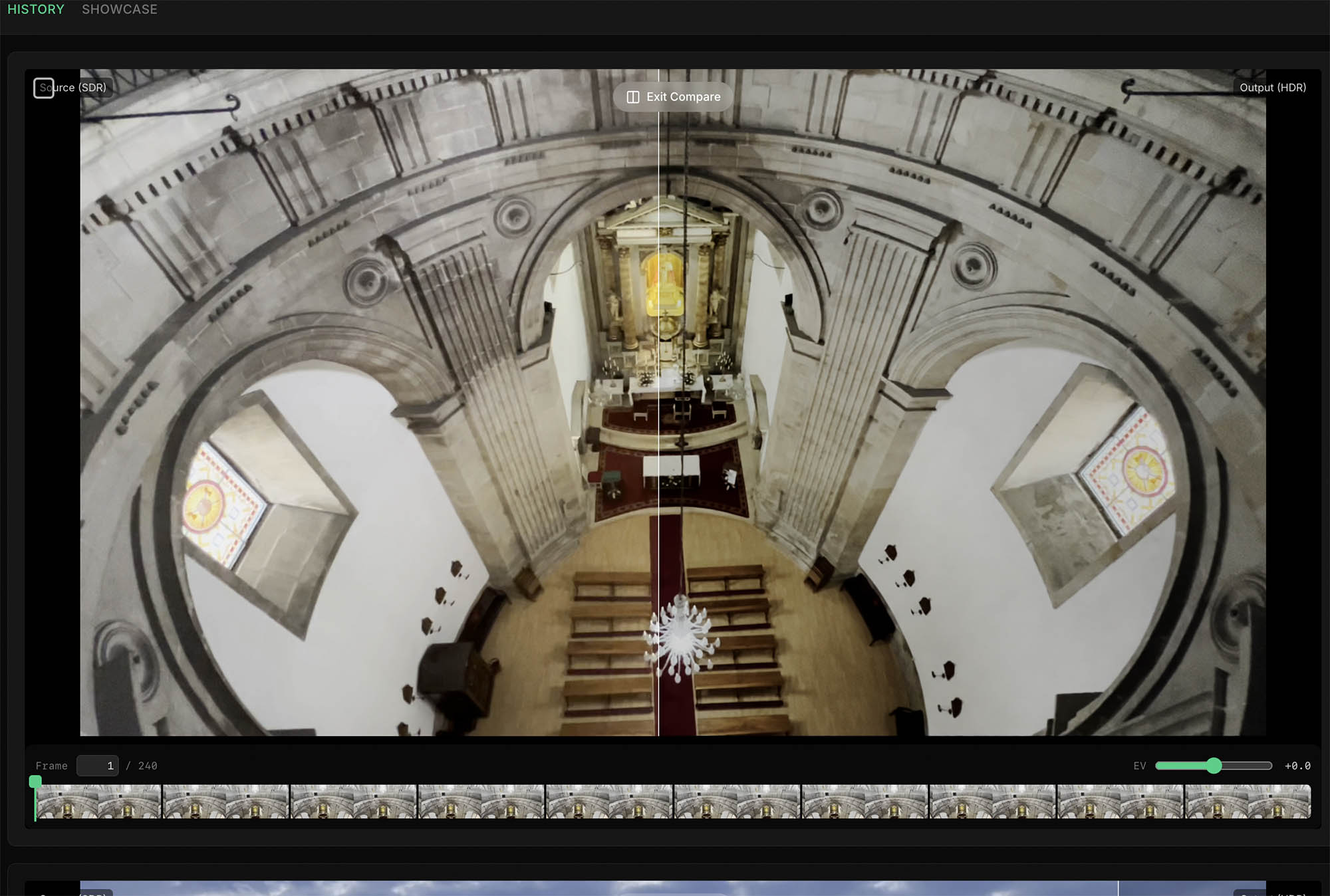
SwitchHDR is aimed at feature films, commercials, restoration, VFX, and broader post-production workflows. It also expands Beeble’s existing suite of AI tools, which has increasingly focused on production-grade relighting, compositing, and virtual production applications.
The tool is not yet perfect, temporial consistency is still a minor issue with complex textures, but fxguide has been testing a range of these HDR AI conversion tools, given how important HDR footage is in a VFX pipeline and SwitchHDR is certainly currently one of the best.
fxguide first wrote about Beeble in June 2023. Since then, the company has grown considerably. More recently, Beeble introduced Canvas, its node-based AI tool, which was shown and discussed at ACM SIGGRAPH in Los Angeles. SwitchHDR continues that same trajectory: using machine learning not as a replacement for artists, but as a way to recover, reshape, and make footage more flexible inside professional image pipelines.