
In this week’s fxpodcast, Juan Salazar, the creative director at Foundry, discusses the latest advancements and strategic shifts within Nuke 17. A primary focus of our conversation is the integration of artificial intelligence through tools like CopyCat and BigCat, which empower artists to automate tedious tasks and manage large-scale data training for entire sequences.
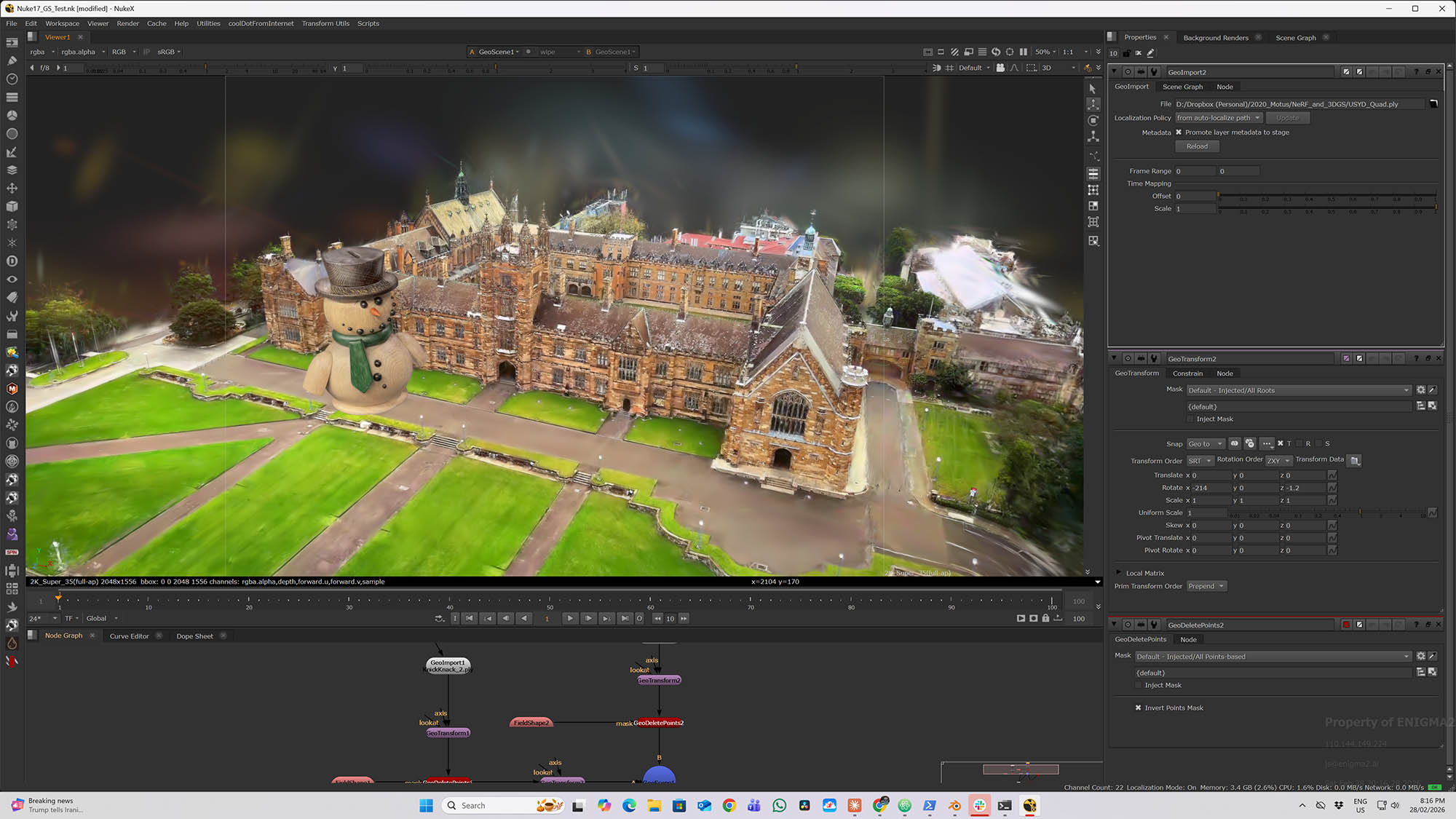
The interview also highlights significant overhauls to the 3D system, including the introduction of Gaussian splats and improved USD support to enhance performance and creative flexibility. Salazar explains that these updates aim to streamline compositing workflows, allowing artists to handle complex reflections and projections more efficiently within a single environment.
Additionally, we cover the technical refinements in this release of Nuke 17 such as Aces 2 integration, faster deep rendering, and a revamped annotation system for better team collaboration. Listen to this week’s fxpodcast to hear Salazar as he explains Foundry’s commitment to providing sophisticated tools that amplify an individual artist’s capability while maintaining high-speed iterative cycles.
Also see our previous story on Nuke 17’s Gaussian Splats
BigCat: scaling machine learning beyond the shot
Nuke 17 expands Foundry’s machine-learning ecosystem with the introduction of BigCat, an evolution of the CopyCat toolset designed for larger training datasets. While CopyCat was originally designed for individual shots or small groups of shots, BigCat enables training across sequences or entire shows, addressing feedback from studios that wanted greater control and scalability.
Interestingly, CopyCat adoption has grown quietly across the industry, with many studios using it internally on productions even when the usage is not widely discussed publicly. BigCat builds on that momentum by giving more technical users the ability to manage large datasets and training workflows directly inside Nuke. Artists can begin in CopyCat and transition into BigCat as projects scale, although training on broader datasets from the outset may reduce the risk of overfitting to specific shots.
The discussion also touched on ongoing industry sensitivity around AI generally. Many uses of machine learning in Nuke involve practical tasks such as cleanup, edge refinement, look transfers between renderers, or lens distortion workflows rather than generative content creation, but studios often remain cautious about publicly discussing AI involvement in production.
GripTape integration and artist amplification
Foundry had previously announced the completion of its acquisition of Griptape, a company focused on enterprise-grade AI orchestration, in a move that signals a significant next step in the evolution of AI inside professional VFX and animation pipelines. Listen to that interview here
Foundry acquires Griptape – an exclusive fxpodcast interview
Looking forward, Foundry’s acquisition of AI orchestration company GripTape is expected to significantly extend machine-learning workflows. The long-term vision is to encapsulate complex AI processes into artist-friendly tools inside Nuke, reducing technical barriers while increasing automation capabilities.
For compositors, this points toward a shift in productivity. Rather than reducing the role of artists, automation is intended to remove repetitive tasks and allow individuals to focus more on creative decision-making and storytelling across sequences. The ability for a single artist to accomplish more within a pipeline could partially reverse decades of increasing departmental specialization.